Who could imagine, that the pursuit of hitting a small ball into a series of holes in as few shots as possible, could entice almost 70 million people1 globally, and spawn a $10bn global industry2? Whilst the sport’s origins are a source of keen debate, the most common theory is that the game as we know it originated in Scotland in the Middle Ages, later spreading across the rest of the UK, the British Empire, and then to the US. The oldest golf course in the world3 is St. Andrews (pictured above), in Scotland, where the game has been played since 1552. St. Andrews is the most frequent host of The Open (30 times, since 1873), and is regarded ‘the home of golf’.
England has the most courses in Europe (1,8724), more than double 2nd place Germany (731). Scotland has 560 courses, though of course in a smaller area than England, and serving (natively) less than 10%5 of the population of England… roughly equating to a course for every 10,000 people (versus England’s 30,000:1 ratio).
These courses vary in their setting, topography and design… typically set out over 9 or (more often) 18 holes, and ranging from lush tree-lined and lake-rich parkland style, to coastal ‘links’ courses, built into the land linking the land and sea, presenting a very different challenge, often including the elements in the exposed locations.
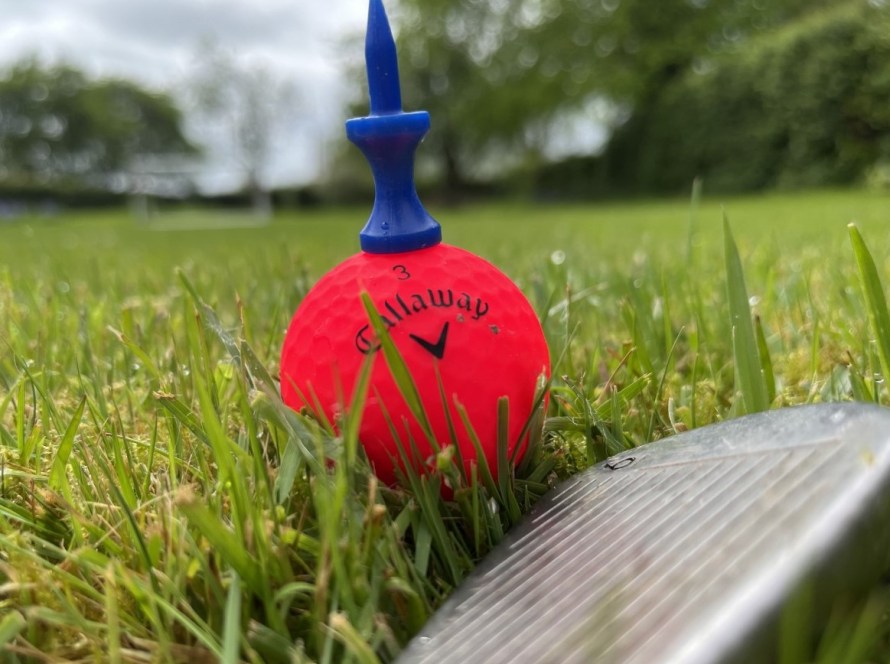
Winston Churchill summed up golf as “a game whose aim is to hit a very small ball into an ever smaller hole, with weapons singularly ill-designed for the purpose”. Whilst his clear frustration with the difficulty of the sport is highly relatable to anyone who’s wielded a club, his critique of the ‘weapons’, however tongue-in-cheek is (understandably) somewhat out of date. Golf clubs have come some way in the last 70 or so years, and now use state-of-the-art technology and materials to offer maximum forgiveness and distance. Each golfer can carry up to 14 clubs, typically a driver for distance off the tee, a putter for control on the greens, and a combination of irons with varying ‘lofts’ (club-face angle) and other qualities, to be equipped for whatever circumstances the next shot requires.
One unusual aspect of golf, is the handicap system, that allows players of potentially very different ability to enjoy competing on a (theoretically) level playing field. Each person’s handicap is calculated based on (up to) their last 20 rounds logged, with their prevailing assigned score compared to those against whom they’re competing.
Every course, and each of its’ holes, has a designed ‘par’; the number of shots that someone with a handicap of 0 (‘scratch’) would expect to take to complete each respective hole and the round in total (typically around 70 for 18 holes). The handicap system then allows calculation of the scores for golfers relative to those they’re competing with, i.e. someone with a handicap of 2 would have to complete a round averaging less than a shot a hole better than a 20 handicap golfer to beat them.
There are far greater complexities to the above, and justice can hardly by done in a brief overview, but hopefully this provides the gist for those looking for a simplistic overview. You can read further on the World Handicap System here and the rules of golf here.
Thankfully, getting into golf has never been easier, with driving ranges, pitch n putt, lessons etc. never having been so accessible, and the financial barrier to entry has never been so (relatively) low.
References: